
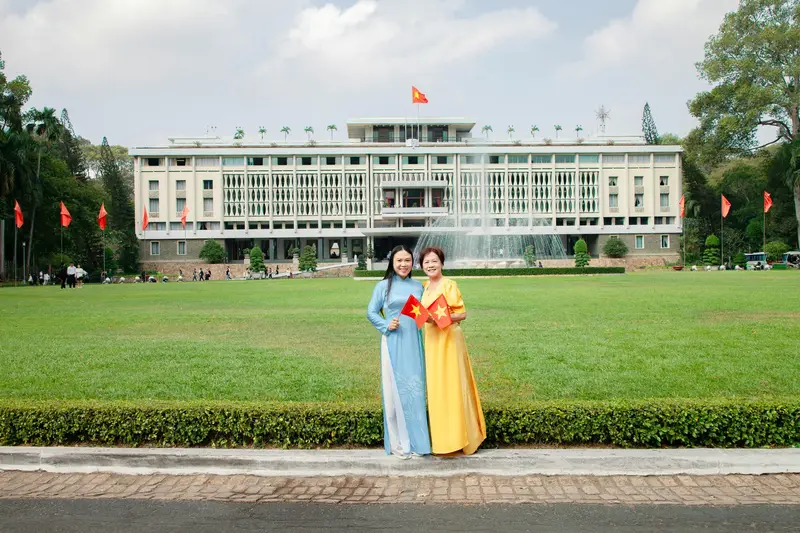
- Core sights
- District 1 (now mainly Sài Gòn and Bến Thành wards), walkable
- Independence Palace
- 07:00–18:00 daily · 80,000 VND adult
- War Remnants Museum
- 07:30–17:30 daily · 40,000 VND (Feb 2026)
- Getting around
- Walk, Grab, Metro Line 1, Saigon Waterbus
- Best months
- December–March (dry season; April is hottest)
- Time needed
- 2–3 days for the city, plus 1–2 day trips
The essential Ho Chi Minh City list is short: Independence Palace, the War Remnants Museum, the colonial core around Nguyễn Huệ and the Opera House, Bến Thành Market, the temples of Chợ Lớn (Chinatown), a street-food evening, a trip on the Saigon River and a day at the Củ Chi tunnels or in the Mekong Delta. Two full days cover the city highlights; a third lets you slow down in the cafés and neighbourhoods that make Saigon worth staying in.
This guide groups 35 things to do by type, with a practical line for each. Old district names are given because that is still how everyone talks, with the new ward in brackets where it helps (districts were abolished on 1 July 2025; see districts → new wards). Opening hours and prices below were checked in November 2026 against official sites or reputable Vietnamese media; museums change fees and times with little notice, so treat them as a guide and check on the day.
Landmarks and history
1. Independence Palace (Dinh Độc Lập)
The 1960s modernist palace where the war ended on 30 April 1975 is preserved almost as it was: cabinet rooms, the presidential office, a rooftop helipad and, best of all, the basement command bunker with its maps and radio rooms. It sits in a park at the top of Lê Duẩn boulevard in District 1 (now Bến Thành ward).
Practical: open 07:00–18:00 every day, including holidays and Tết, unless the palace announces an exception. Tickets are 80,000 VND for adults, 40,000 VND for students and seniors and 20,000 VND for children aged 6–17 (official site, checked November 2026). Allow 90 minutes; go at opening time to beat tour groups.
2. War Remnants Museum (Bảo tàng Chứng tích Chiến tranh)
One of Vietnam’s best-known museums documents the Vietnam War (called the American War in Vietnam) through photographs, weapons and the effects of Agent Orange. Some galleries are graphic and many visitors find it emotionally heavy; the courtyard displays aircraft and tanks, and a reconstruction of the Côn Đảo “tiger cages”. It is in District 3 (now Xuân Hòa ward), a 15-minute walk from the palace.
Practical: 07:30–17:30 daily, ticket counter closes at 17:00. The fee was 40,000 VND per person in February 2026, free for under-6s and half price for students; online booking with timed QR entry started in February 2026. Some 2026 travel guides report a higher fee, so check the museum’s own site before you go. Allow two hours.
3. Ho Chi Minh City Museum (Gia Long Palace)
A cream-coloured 1890 mansion on Lý Tự Trọng street telling the city’s story from the Nguyễn dynasty through trade, crafts and the 20th-century wars. After refurbishment it reopened in 2026 together with its secret underground bunker, which visitors can walk through again. The grounds are a favourite spot for wedding photos.
Practical: reported ticket 30,000 VND including the bunker (Dân Trí, April 2026); usual hours are about 08:00–17:00. Five minutes’ walk from the Opera House metro station.
4. Notre-Dame Cathedral Basilica (Nhà thờ Đức Bà)
The red-brick cathedral, built with materials shipped from France in the 1870s–80s, has been under restoration since 2017. A milestone came on 19 March 2026, when new gold-plated crosses were lifted back onto the twin towers; the head of the restoration board has said no completion date has been set. You can admire the façade and the square, but expect scaffolding or fencing and limited access inside outside Mass times.
5. Saigon Central Post Office (Bưu điện Thành phố)
Directly opposite the cathedral, this working post office from the 1890s has a vaulted hall, painted maps of old Cochinchina and a large portrait of Hồ Chí Minh. You can still post a card home from the counters.
Practical: free to enter. Published hours disagree (roughly 07:00 to 17:00–19:00, with shorter Sunday hours in some listings), so arrive before 17:00 to be safe.
6. Nguyễn Huệ walking street and City Hall
The broad pedestrian boulevard from the river to the floodlit City Hall (People’s Committee building, viewable from outside only) has been car-free since 2015. Evenings are lively with families, buskers and kids on scooters; during Tết it becomes the famous flower street. The Opera House metro station opens at its northern end.
7. Saigon Opera House (Nhà hát Thành phố)
The 1900 Belle Époque theatre is best appreciated from Lam Sơn Square at dusk, or from a seat: contemporary circus and bamboo shows are staged regularly. Check the theatre’s programme and see theatres & performing arts.
8. Hồ Chí Minh Museum at Nhà Rồng Wharf
The old customs house on the river, where the young Nguyễn Tất Thành (later Hồ Chí Minh) left Saigon in 1911, now holds a museum about his life. The grounds were renovated from May 2026 and inaugurated on 29 August 2026. It is in District 4 (now Xóm Chiếu ward) at the mouth of the Bến Nghé canal.
War Remnants Museum & Independence Palace Tour (with free eSIM)
A tour of the War Remnants Museum and Independence Palace, with a free eSIM.
Check availability Booked on GetYourGuideHalf-Day Historical Saigon City Tour (Group or Private)
Half dayA half-day tour of Saigon’s historical sights, in a group or privately.
Check availability Booked on GetYourGuideTemples, pagodas and churches
9. Jade Emperor Pagoda (Chùa Ngọc Hoàng)
A smoky, atmospheric Taoist–Buddhist temple from the early 20th century in Đa Kao (now Tân Định ward), packed with carved figures of deities and the Hall of Ten Hells. Visitors buy turtles to release in the pond and pray for children at the shrine to Kim Hoa. Free; dress modestly.
10. Thiên Hậu Temple (Chùa Bà Thiên Hậu)
Chợ Lớn’s most famous Cantonese assembly hall honours the sea goddess Mazu. Look up at the porcelain friezes on the roof and the giant incense coils hanging from the ceiling, which burn for weeks. It is on Nguyễn Trãi street in District 5 (now Chợ Lớn ward area).
11. Chợ Lớn assembly halls
Within a few blocks of Thiên Hậu you can see several other Chinese clan halls (hội quán) and the Cha Tam church, where President Ngô Đình Diệm sheltered before his death in 1963. Pair them with Bình Tây Market (below) for a half-day walk.
12. Tân Định Church
The candy-pink Gothic Revival church on Hai Bà Trưng street is the city’s most photographed after Notre-Dame. Go early morning, then eat at Tân Định market next door.
13. Vĩnh Nghiêm Pagoda and Xá Lợi Pagoda
Two large modern Buddhist temples in District 3: Vĩnh Nghiêm has a seven-storey tower; Xá Lợi was a centre of Buddhist protest in 1963. Both are active places of worship. For more, see pagodas & temples and churches.
Temple etiquetteCover shoulders and knees, take off shoes where you see others doing so, don’t point your feet at altars and ask before photographing people at prayer. Small donations go in the box, not to individuals. More in etiquette & tipping.
Markets
14. Bến Thành Market
The clock-towered market at the end of Lê Lợi is the city’s best-known symbol. Inside are fabric, coffee, dried fruit, lacquerware and a food court of noodle and dessert stalls. Prices for visitors start high, so bargain politely. The square in front has reopened after years of metro works, and the Bến Thành metro station is underneath.
15. Bình Tây Market (Chợ Lớn)
The wholesale heart of Chinatown, a 1930s courtyard building where traders sell everything from dried seafood to plastic buckets by the sack. Mornings are busiest and most photogenic. It is in old District 6 (now Bình Tây ward).
16. Tân Định and Hồ Thị Kỷ markets
Tân Định is a local market known for fabric; Hồ Thị Kỷ in District 10 is a flower market by day and a narrow alley of snack stalls by night. Both feel far less touristy than Bến Thành. Full listings: markets and our shopping guide.
Museums and galleries
17. Fine Arts Museum (Bảo tàng Mỹ thuật)
Three colonial-era buildings near Bến Thành, with Vietnamese lacquer and silk painting, Champa and Óc Eo sculpture, and wartime propaganda art. The architecture alone, with stained glass and tiled stairwells, is worth the small fee. Usually open about 08:00–17:00.
18. Museum of Vietnamese History
Inside the zoo grounds (separate entrance), with artefacts from Đông Sơn bronze drums to Champa sculpture and a water-puppet theatre. Combine with the zoo for a family morning; see with kids.
19. Áo Dài Museum and Southern Women’s Museum
Smaller museums for specific interests: the history of Vietnam’s national dress (in Thủ Đức, near the Suối Tiên metro terminus) and the role of southern women in history and daily life (District 3). Listings: museums and galleries.
Views from above
20. Saigon Skydeck, Bitexco Financial Tower
The lotus-bud tower with the helipad has an enclosed observation deck on the 49th floor overlooking the river bend and District 1. Resellers list hours of about 09:30–21:30; there is no official price list online, so check at the desk. Go just before sunset to see the city by day and by night.
21. Landmark 81 SkyView
Vietnam’s tallest building, in Bình Thạnh (now Thạnh Mỹ Tây ward), has its observation deck on floors 79–81, with views down the river to District 1 and over Thủ Thiêm. Published hours range from about 09:00/10:00 to 22:00 and weekend prices have historically been higher than weekdays; confirm on Landmark 81’s official channels. Take Metro Line 1 to Tân Cảng or Văn Thánh Park station.
22. Rooftop bars
The free alternative: buy a drink instead of a ticket. Hotel rooftops along the river and in Bến Thành have some of the best sunset views. See our nightlife guide and rooftop & sky bars.
Saigon Skydeck at Bitexco Financial Tower
Entry to the Saigon Skydeck observation deck in the Bitexco Financial Tower.
Check availability Booked on GetYourGuideLandmark 81 SkyView Observatory Ticket with VR Game
An entry ticket to the Landmark 81 SkyView observatory with a VR game.
Check availability Booked on GetYourGuideOn the Saigon River
23. Ride the Saigon Waterbus
The public waterbus runs from Bạch Đằng pier in District 1 upriver to Thảo Điền, Thanh Đa and Linh Đông, with a round trip around 30,000 VND. It is the cheapest river cruise in town, best in the late afternoon. Timetable and booking: Saigon Waterbus.
24. Sunset or dinner cruise
Dinner boats leave from the District 1 waterfront every evening, from simple buffet boats to small luxury cruises. Book a sunset departure for the best light; see tours for how to choose, and river cruises.
25. Watch the river from Bạch Đằng Wharf Park
The riverside park facing Thủ Thiêm is where locals come for the breeze in the evening. A new pedestrian bridge from here to Thủ Thiêm closed its main arch in October 2026 and is targeted to open before Tết 2027; the opening date has slipped before, so check the news.
Icon Saigon Sunset Cruise
A sunset cruise on the Saigon River.
Check availability Booked on GetYourGuideSaigon River Dinner Cruise
A dinner cruise on the Saigon River in Ho Chi Minh City.
Check availability Booked on GetYourGuideFood experiences
26. Take a street-food tour
Saigon’s food is the main reason many people come back. A guided evening on foot or on the back of a motorbike takes you to stalls you would never find alone, and explains what to order. Our food guide covers the dishes; tours explains walking versus motorbike options.
27. Eat your way down Vĩnh Khánh street (District 4)
District 4’s seafood street fills with plastic stools from late afternoon: snails (ốc), grilled scallops, clams in lemongrass broth. Point at what others are eating and agree prices before you order. It is in today’s Khánh Hội ward area.
28. Drink coffee the Saigon way
Sit on a low stool with a cà phê sữa đá (iced coffee with condensed milk), visit the café-packed apartment block at 42 Nguyễn Huệ, or try a coconut or egg coffee. See coffee culture.
29. Take a cooking class
Most classes start with a market visit and end with lunch of what you cooked: spring rolls, bánh xèo (crispy pancakes), a noodle soup. See cooking classes.
Motorbike Street Food Tour with 12 Tastings
A street-food tour by motorbike with 12 tastings.
Check availability Booked on GetYourGuideDistrict 4 Street Food Walking Tour
A walking tour of District 4’s street food.
Check availability Booked on GetYourGuideNeighbourhood walks
30. District 1 heritage loop
Start at the Opera House, walk Đồng Khởi (the old rue Catinat) to Notre-Dame and the Post Office, cut through to Independence Palace, then back via the Ho Chi Minh City Museum and Nguyễn Huệ. About 3 km, half a day with stops. Duck into the alleys (hẻm) and old apartment blocks along the way.
31. Chợ Lớn (Chinatown)
Take a Grab to Bình Tây Market, then walk to the temples on Nguyễn Trãi and Lão Tử streets and finish with dim sum or duck noodles. Mornings are best.
32. Thảo Điền
The riverside expat enclave in old District 2 (now An Khánh ward) is all leafy lanes, cafés, galleries and brunch spots. Ride Metro Line 1 to Thảo Điền station and walk down Quốc Hương street.
33. Ride the metro for the views
Line 1 runs underground under District 1 and then climbs onto a viaduct over the Saigon River and Thủ Đức. A one-way ride from Bến Thành to Suối Tiên costs 20,000 VND in cash; see how to ride the metro.
Chợ Lớn Cultural Heritage & Market Walking Tour
A walking tour of Chợ Lớn’s cultural heritage and markets.
Check availability Booked on GetYourGuideCity Highlights Tour by Cyclo
A tour of Ho Chi Minh City’s highlights by cyclo.
Check availability Booked on GetYourGuideDay trips
34. Củ Chi tunnels
The wartime tunnel network north-west of the city centre is the most popular day trip. Bến Đình is closer and busier; Bến Dược is further but has more of the original site and the memorial temple. Both open about 07:00–17:00. Admission for foreign visitors is reported differently by different sources (and some include a guide fee), so check at the gate. Details in day trips.
35. Mekong Delta
A day trip to Mỹ Tho and Bến Tre gives you boats through coconut-palm canals, fruit orchards and coconut candy workshops. To see a floating market properly (Cái Răng, near Cần Thơ), you need to stay overnight. Also worth a day: the Cao Đài Holy See and Bà Đen mountain in Tây Ninh, the Cần Giờ mangroves and the beach town of Vũng Tàu.
Compare all options, from public bus to speedboat, in our day trips guide and tours guide.
Củ Chi Tunnels Guided Tour
A guided tour of the Củ Chi tunnels from Ho Chi Minh City.
Check availability Booked on GetYourGuide1-Day Mekong Delta Tour: Floating Market & Islet
1 dayA one-day Mekong Delta tour with a floating market and an islet.
Check availability Booked on GetYourGuidePlan your time
Most of the city sights cluster in District 1 and District 3, so base yourself there on a first visit (see where to stay). Plan sightseeing for the morning and late afternoon: from March to May the midday heat is intense, and from May to November afternoon downpours are common (see weather and best time to visit).
Grab and Xanh SM are the easiest way to hop between sights (Grab & taxis); crossing the street is easier than it looks if you walk at a slow, steady pace and let motorbikes flow around you. For full day-by-day plans see itineraries.
- Mondays: most big sights are open daily, but smaller museums and galleries sometimes close; check before you go.
- Tết (Lunar New Year, 6 February 2027): Independence Palace stays open; many restaurants and shops close for several days. See Tết in Saigon.
- Dress: shoulders and knees covered for temples, palace and museums.
- Cash: small sights, markets and street food are cash-first; see money.
Frequently asked questions
What is the number one thing to do in Ho Chi Minh City?
For history, Independence Palace and the War Remnants Museum, which are a 15-minute walk apart. For atmosphere, a street-food evening in District 1, 3 or 4.
How many days do you need in Ho Chi Minh City?
Two full days cover the main city sights; three to four days let you add the Củ Chi tunnels or a Mekong Delta day trip without rushing.
How much is the ticket for Independence Palace?
80,000 VND for adults, 40,000 VND for students and seniors and 20,000 VND for children aged 6–17, open 07:00–18:00 daily (official site, checked November 2026).
Is Notre-Dame Cathedral in Saigon open?
It remains an active church but has been under restoration since 2017; new crosses went back on the towers in March 2026 and no completion date has been set. Expect scaffolding and limited interior access.
Is Ho Chi Minh City walkable?
District 1’s core is walkable, with Nguyễn Huệ, the Opera House, Notre-Dame, the Post Office and Independence Palace within about 2 km. For longer hops use Grab or Metro Line 1.
What can I do in Saigon when it rains?
Museums, the Ho Chi Minh City Museum bunker, malls, cooking classes, cafés and the Skydeck. See the rainy-day plan in our itineraries.
Sources
- Independence Palace — official visitor information (hours, tickets) (checked 2026-11-23)
- SGGP — War Remnants Museum launches online ticketing (10 Feb 2026) (checked 2026-11-23)
- Dân Trí / DTiNews — HCMC Museum and bunker reopen (26 Apr 2026) (checked 2026-11-23)
- DTiNews — HCMC museums over Tết 2026 (checked 2026-11-23)
- Tuổi Trẻ News — Gold-plated crosses return to Notre-Dame (19 Mar 2026) (checked 2026-11-23)
- Tuổi Trẻ News — Renovated Hồ Chí Minh Museum (Nhà Rồng) inaugurated (29 Aug 2026) (checked 2026-11-23)
- Việt Nam News — Saigon River pedestrian bridge main span installed (Oct 2026) (checked 2026-11-23)
- Greensm — Landmark 81 SkyView floors and reference prices (Dec 2024) (checked 2026-11-23)
- VnExpress — 42 Nguyễn Huệ and the 2015 pedestrian street (checked 2026-11-23)
- Saigon Waterbus — official site (checked 2026-11-23)