
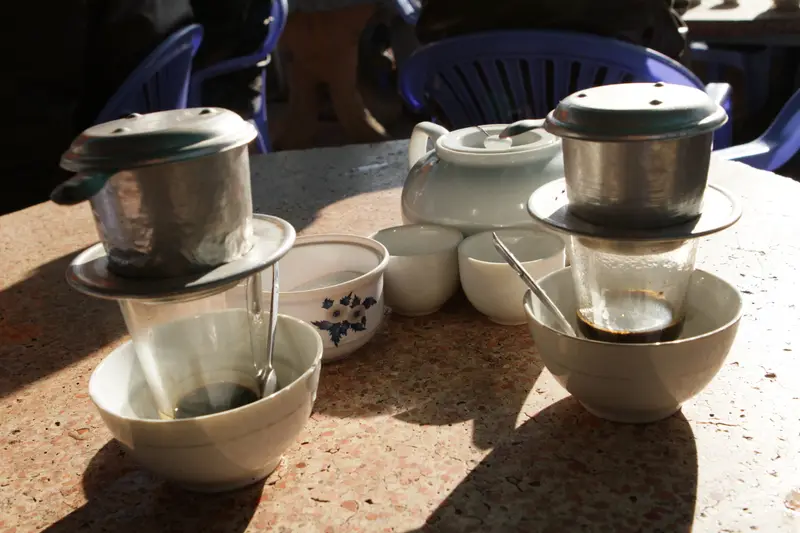
- Classic order
- Cà phê sữa đá (iced, condensed milk)
- Bean
- Mostly robusta; Vietnam is No. 2 producer
- Brewer
- Phin — a small metal drip filter
- Café apartment
- 42 Nguyễn Huệ, District 1
- Rush hour
- Early morning and mid-afternoon
In Saigon, coffee is less a drink than a place to be. Office workers stop at a sidewalk stall before 07:00, friends spend whole afternoons in garden cafés, and students colonise air-conditioned chains with laptops. The default order is cà phê sữa đá: dark-roasted robusta dripped slowly through a phin filter onto sweetened condensed milk, then poured over ice. It is strong, sweet and very cold — exactly what the climate demands.
Vietnam is the world’s second-largest coffee producer and the leading supplier of robusta, which is grown mainly in the Central Highlands. USDA forecasts in 2026 put production at over 30 million 60-kg bags, nearly all robusta. That is why Vietnamese coffee tastes bold and chocolatey rather than fruity — and why specialty roasters in the city are now working with local arabica too.
What to order
| Vietnamese | What it is |
|---|---|
| Cà phê sữa đá | Phin coffee with condensed milk over ice — the classic |
| Cà phê đen đá | Black iced coffee, usually pre-sweetened; ask “không đường” for no sugar |
| Bạc xỉu | Mostly milk with a little coffee — Saigon’s answer to a latte, of Chinese-Saigonese origin |
| Cà phê nóng | Hot coffee; add “sữa” for milk |
| Cà phê trứng | Egg coffee: coffee topped with whipped egg yolk and sugar (a Hanoi invention) |
| Cà phê dừa | Coconut coffee: coffee with blended coconut milk and ice, slushie-style |
| Cà phê muối | Salt coffee: coffee topped with lightly salted cream (from Huế) |
| Trà đá | Free or very cheap iced tea served alongside at many cafés |
Sizes are small and strong. If the coffee arrives with the phin still dripping on the glass, wait until it finishes, stir in the condensed milk, then pour it over the ice.
How the phin works
The phin is a small aluminium or stainless-steel cup with a perforated base and a press. Coarse ground coffee goes in, a splash of hot water blooms it, then the cup is filled and left to drip for about four to five minutes. It makes a concentrated, low-volume brew similar in strength to espresso. Phin filters cost very little in markets and make a practical souvenir; buy ground coffee from a roaster rather than tourist gift packs.
Want to learn? Coffee workshops teach phin brewing plus egg, coconut or salt coffee.
Egg Coffee & 4 Traditional Vietnamese Brews Workshop
A coffee workshop covering egg coffee and four traditional Vietnamese brews.
Check availability Booked on GetYourGuideCoffee Culture Tour with Workshop
A tour of Ho Chi Minh City’s coffee culture with a workshop.
Check availability Booked on GetYourGuideCoconut & Egg Coffee Making Class
A class in making coconut and egg coffee.
Check availability Booked on GetYourGuideEgg, coconut and salt coffee
Egg coffee is credited to Nguyễn Văn Giảng, a bartender in Hanoi, who is said to have whipped egg yolk with sugar as a substitute for scarce milk in the 1940s; the story is told mainly by his family and later media. In Saigon you will find it in Hanoi-style cafés and many tourist cafés. It tastes like a coffee tiramisu.
Coconut coffee — blended coconut milk, condensed milk and ice topped with coffee — is closely associated with the Cộng Cà Phê chain and is now widely available. Salt coffee (cà phê muối), from Huế, adds a lightly salted cream to cut the bitterness; it has spread through the south in recent years.
Where to drink it
Sidewalk stalls (cà phê cóc)
A thermos, a stack of tiny plastic stools and a view of the street. The cheapest coffee in the city, and the most local. Mornings are busiest. Some stalls are fixtures in the same alley for decades.
Vietnamese chains
Highlands Coffee, Phúc Long (known for tea), The Coffee House, Katinat, Trung Nguyên Legend and Cộng Cà Phê are all over the city, including at the airport and in malls. Reliable air-conditioning, Wi-Fi and toilets, and a good place to work for an hour.
Specialty roasters
Third-wave cafés roast Vietnamese arabica and robusta and serve pour-overs, espresso and cold brew alongside phin coffee. They cluster in District 1, District 3 and Thảo Điền. Find them in cafés & coffee roasters.
Garden and hidden cafés
Old villas and alley houses turned into leafy cafés, popular with students and couples. Many are up a staircase or down a hẻm (alley) with only a small sign at the street.
The café apartment: 42 Nguyễn Huệ
Halfway down Nguyễn Huệ walking street stands a nine-storey 1960s apartment block whose balconies are now almost entirely cafés, tea shops and boutiques. According to its building administrator, interviewed by VnExpress, it was a plain residential block until the walking street opened in 2015, when shops started moving in. Take the lift (a small fee is sometimes charged) or the stairs, browse floor by floor and choose a balcony overlooking the boulevard; sunset and evenings are busiest.
Several other old apartment blocks in District 1 have similar café-and-boutique conversions. Many are still partly residential, so be considerate on the stairs.
Café etiquette
- Order and pay: at chains you order at the counter; at traditional cafés you sit and someone takes your order, and you pay when you leave.
- Iced tea (trà đá) often comes free; refills too.
- Linger: staying for hours is completely normal, even on one drink.
- Laptops: fine at chains and specialty cafés; less so at small family-run spots at lunch time.
- Smoking: some open-air cafés allow smoking; indoor air-conditioned spaces usually don’t. Note that vapes and e-cigarettes are banned in Vietnam.
- Parking: if you arrive by motorbike, attendants give you a ticket; parking is sometimes free for customers, sometimes a few thousand dong.
Take some home
Buy whole beans or ground coffee from a roaster, a supermarket or Bến Thành Market (where prices are higher and quality varies). Be sceptical of cheap “weasel coffee” (cà phê chồn) sold to tourists; there are also animal-welfare concerns about its production. A phin filter and a tin of condensed milk complete the kit. See shopping.
Frequently asked questions
What coffee should I order in Saigon?
Start with cà phê sữa đá (iced coffee with condensed milk). If you prefer it milder, order bạc xỉu; for black, cà phê đen đá.
What is the café apartment in Ho Chi Minh City?
The 1960s apartment block at 42 Nguyễn Huệ in District 1, whose floors are now packed with small cafés and shops overlooking the walking street.
Is Vietnamese coffee stronger than regular coffee?
Usually yes. It is mostly robusta, which has more caffeine than arabica, brewed concentrated through a phin.
Where can I try egg coffee in Ho Chi Minh City?
Many Hanoi-style and tourist cafés in District 1 serve it, and coffee workshops teach you to make it.
What is salt coffee?
Cà phê muối, from Huế: coffee topped with lightly salted cream. It has become popular across Saigon in recent years.
Sources
- Việt Nam News — Vietnam cements status as world’s No.2 coffee producer (May 2026) (checked 2026-11-23)
- USDA FAS — Vietnam: Coffee Annual (checked 2026-11-23)
- VnExpress — Saigonese find retro getaways in old apartment buildings (42 Nguyễn Huệ) (checked 2026-11-23)
- Vietcetera — The history of egg coffee (checked 2026-11-23)
- UK FCDO — Vietnam: vapes and e-cigarettes banned (checked 2026-11-23)