
- IDP accepted
- 1968 Vienna Convention only
- Not accepted
- 1949 Geneva IDPs (e.g. US, Canada, Australia, NZ)
- ASEAN licences
- Valid for the vehicle class they cover
- Helmets
- Compulsory for rider and passenger
- Alcohol
- Zero tolerance for all drivers and riders
- Bike/e-bike share
- TNGo-HCM app
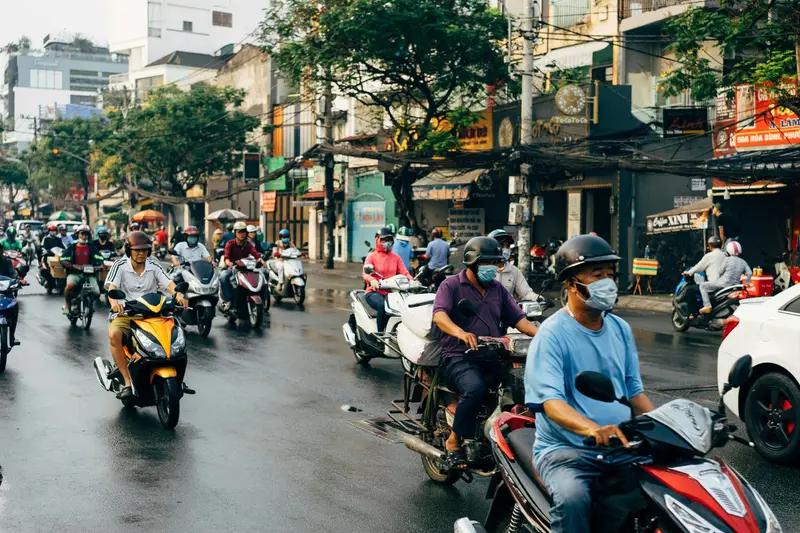
Motorbikes are how Ho Chi Minh City moves: millions of them fill the streets from dawn to midnight. Renting one is easy, but riding legally as a foreigner is not. You need either an International Driving Permit issued under the 1968 Vienna Convention together with your home motorbike licence, a licence from an ASEAN country that covers motorbikes, or a Vietnamese licence. IDPs issued under the 1949 Geneva Convention, which is what the US, Canada, Australia, New Zealand and some others issue, are not valid in Vietnam.
If you don’t have the right paperwork, you are riding illegally, and travel insurance generally won’t cover you in an accident. For most short-term visitors, the smarter choice is to ride on the back with a GrabBike or Xanh SM Bike driver, or book a guided motorbike tour.
Licences and the law for foreigners
- 1968-convention IDP + home licence: valid, provided your home licence covers motorbikes. A car-only licence does not let you ride a motorbike.
- 1949-convention IDP: not valid in Vietnam. Vietnam News lists the US, Canada, Australia, New Zealand, South Africa and Israel among countries that issue only this type.
- ASEAN licence: licences from ASEAN member states (for example Singapore, Malaysia, Thailand, the Philippines) are valid without an IDP for the vehicle class they cover.
- Vietnamese licence: residents with a Temporary Residence Card can convert a home licence (translation, medical check) or take the local test. Short-stay tourists generally cannot get a Vietnamese licence; check eligibility with the traffic police.
- Alcohol: Vietnam has a zero-tolerance rule for drink-driving, which applies to motorbikes too.
- Fines: traffic fines were raised under Decree 168/2024 from 1 January 2025 and apply to foreigners. Police checks on foreigners riding without valid permits are reported regularly, for example in Khánh Hòa in May 2026.
Insurance warningTravel and medical insurance typically covers motorbike accidents only if you were riding legally, with the right licence, a helmet and no alcohol. Check your policy wording before you rent.
Renting a motorbike
- Rental shops cluster around the Phạm Ngũ Lão / Bùi Viện area, Thảo Điền and near hotels; many deliver to your door. The directory lists rental businesses.
- Expect to leave a deposit; avoid leaving your passport if you can. Photograph the bike, its scratches and its registration papers before riding off.
- Choose an automatic scooter unless you are used to manual gears.
- Insist on a good-quality, properly fitting helmet, not a thin “fashion” helmet.
- Ask how and where to refuel: petrol stations are plentiful, and attendants fill the tank for you.
Traffic culture: how Saigon rides
- Traffic flows rather than stops: riders merge, weave and give way by eye contact and small adjustments. Ride predictably and avoid sudden moves.
- The horn is a signal (“I’m here”), not usually aggression.
- Bigger vehicles have de facto priority. Expect motorbikes riding against traffic close to the kerb, and on pavements during jams.
- Rain makes roads slick and floods some streets in the wet season; see rainy season & flooding.
- Parking: use attended parking (“giữ xe”) and keep the ticket. Many shops and cafés have a parking attendant on the pavement.
Crossing the street
For first-time visitors, crossing a busy Saigon road is the real adventure. The technique locals use:
- Use a pedestrian crossing or traffic light where there is one, and cross with local pedestrians if you can.
- Look both ways, including the “wrong” way: motorbikes ride against traffic near the kerb.
- Step out when there is a reasonable gap, raise a hand slightly if you like, and walk at a slow, steady pace.
- Don’t stop suddenly, run or step back. Riders judge your position and steer around you.
- Watch for cars, buses and trucks, which will not swerve the way motorbikes do; wait for them to pass.
Walking in the city
Central District 1 is walkable, especially Nguyễn Huệ walking street and the riverside, and Bùi Viện, which is reported to be pedestrian-only on weekend evenings (about 19:00–02:00). Elsewhere, pavements are often taken up by parked motorbikes, street-food stalls and the occasional rider escaping a jam, so you will walk on the road edge at times. Go out early morning or after sunset to avoid the heat, and carry water. In the rainy season, short heavy downpours are common in the afternoon.
Cycling and bike share
Cycling in central Saigon is for the confident, but quiet backstreets, Thảo Điền and the outskirts are pleasant, and guided cycling tours head into greener areas.
The city’s public bike-share system is run through the TNGo-HCM app; it had 500 bicycles at 52 stations in the central area in March 2026, when electric bikes were added with a free trial (including a station near the former Saigon Tax Trade Center on Nguyễn Huệ). Planned e-bike fees after the trial were 10,000 VND for 15 minutes up to 110,000 VND for four hours. Check current prices in the app. Folding bikes (folded, in a bag) can be taken on Metro Line 1 (see how to ride the metro).
See the city from the back of a bike
A guided motorbike or vintage Vespa tour is the easiest way to experience Saigon traffic safely: an experienced local rides, you sit behind, and you reach street-food spots and neighbourhoods you would never find alone.
Discover Saigon’s Local Street Food and Sights by Motorbike
A motorbike tour of Saigon’s local street food and sights.
Check availability Booked on GetYourGuideIconic Saigon Motorbike Signature Food Tour
A signature food tour of Saigon by motorbike.
Check availability Booked on GetYourGuideHo Chi Minh City Vintage Vespa Night Food and Sightseeing Tour
An evening food and sightseeing tour on a vintage Vespa.
Check availability Booked on GetYourGuideGood Morning Saigon by Motorbike
A morning tour of Saigon by motorbike.
Check availability Booked on GetYourGuideCycling into a Hidden Green Side of Saigon
A cycling tour into a greener, quieter side of Saigon.
Check availability Booked on GetYourGuideFrequently asked questions
Can I ride a motorbike in Vietnam with an international driving permit?
Only with a 1968 Vienna Convention IDP plus a home licence that covers motorbikes. 1949-convention IDPs are not accepted.
Is a US international driving permit valid in Vietnam?
No. The US issues 1949-convention IDPs, which Vietnam does not recognise.
Do I need a helmet on a motorbike taxi?
Yes. Helmets are compulsory for riders and passengers; Grab and Xanh SM drivers carry one for you.
How do you cross the road in Ho Chi Minh City?
Use crossings where possible, then walk slowly and steadily without stopping or running so riders can steer around you. Watch for cars and buses.
Is there bike sharing in Ho Chi Minh City?
Yes: the TNGo-HCM app runs public bikes in the centre, with e-bikes added in March 2026.
Does travel insurance cover motorbike accidents in Vietnam?
Usually only if you were riding legally with a valid licence and a helmet. Check your policy.
Sources
- Vietnam News — using the roads in Viet Nam as a foreigner (2026) (checked 2026-11-23)
- Tuổi Trẻ — foreigners caught riding without IDPs in Khánh Hòa (May 2026) (checked 2026-11-23)
- Tuổi Trẻ — HCMC launches public e-bike service (15 Mar 2026) (checked 2026-11-23)
- Tiền Phong — folding bikes on Metro Line 1 (checked 2026-11-23)