
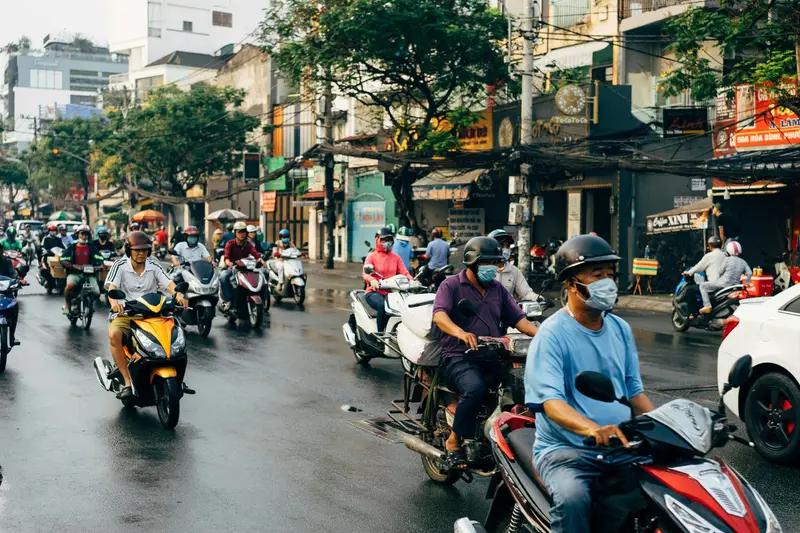
- Most common crime
- Bag and phone snatching from motorbikes
- Biggest physical risk
- Road traffic
- Police
- 113
- Tourist hotline
- 1022, ext. 8
- Drugs
- Severe penalties, including the death penalty for trafficking
- ID
- Carry a copy of your passport and visa
Ho Chi Minh City is a safe city for most visitors and residents: violent crime against foreigners is uncommon and the streets are busy until late. The crimes you are most likely to meet are opportunistic: phones and bags snatched by thieves on motorbikes, pickpocketing in crowds, and a steady menu of overcharging scams aimed at newcomers.
The greater danger is the road. Traffic is dense, motorbikes ride on pavements, and accidents are common. And because Vietnamese law is strict on drugs, ID and some online and political activity, it pays to know a few rules before you arrive.
Bag and phone snatching
The signature Saigon crime is the drive-by snatch: two people on a motorbike grab a phone held at the kerb or a bag hanging on the traffic side. It happens most in tourist areas and at night, and the UK Foreign Office notes petty crime rises around Christmas and Tết.
- Carry bags across your body on the side away from the road.
- Step back from the kerb, or into a shop doorway, to use your phone or check a map.
- In a Grab bike or cyclo, keep the phone in a zipped pocket.
- If someone grabs, let go. Being dragged from a motorbike causes serious injuries; the Foreign Office advises surrendering valuables rather than risking injury.
- Pickpocketing happens on crowded buses and trains and in markets such as Bến Thành.
If something is stolen, see reporting a crime for the police report you need for insurance.
Scams to know about
Most scams are about money, not danger, and almost all are avoidable by agreeing a price first or paying through an app.
| Scam | How it works | How to avoid it |
|---|---|---|
| Rigged or fake taxis | Look-alike Vinasun or Mai Linh cars, fast meters, or a fixed ‘price’ that turns out to be in US dollars. Airport cases include fares of several million đồng. | Use Grab, Xanh SM or Be and book in the app, or take a taxi from the official airport queue. See Grab and taxis. |
| Cyclo rides | A cheap quoted price becomes a much larger demand at the end, sometimes ‘per person’ or ‘per hour’. | Agree the total price, route and duration in writing, or book through your hotel or a tour company. |
| Shoe-shine and coconut sellers | Someone starts polishing your shoes uninvited, or hands you a fruit pole for a photo, then demands a large fee. | A firm ‘không, cảm ơn’ (no, thank you) and keep walking. Don’t pose for photos with props unless you want to pay. |
| Money changing | Short-changing, or swapping a 500,000 note for a similar-looking 20,000 note (both are blue-ish polymer). | Count notes yourself and change money only at banks or licensed counters. See money. |
| Fake tour and visa sites | Look-alike websites sell e-visas or tours at inflated prices, or take payment for tours that never happen. | Apply for e-visas only at evisa.gov.vn (see visas); book tours through established platforms or operators. |
| Free ‘shuttle’ from airport or station | An unrequested free transfer leads to an overpriced hotel or a demand for payment. | The Foreign Office warns these may be scams unless arranged in advance. |
| Job and investment scams | Offers of easy jobs or online ‘tasks’ that end in passport confiscation or forced scamming work. | Never give your passport to an employer; check employers carefully. |
The city is taking overcharging more seriously: in August 2026 the Department of Tourism and city police agreed to step up patrols and inspections against aggressive solicitation, overcharging, theft and online scams. Report problems to the tourist line 1022, extension 8.
Traffic: the real risk
Millions of motorbikes share the roads with cars, buses and pedestrians, and traffic rules are loosely followed. The Foreign Office says motorbike accidents are common.
- Crossing the road: walk at a slow, steady pace and don’t stop suddenly or run; riders steer around predictable pedestrians. Watch for bikes riding the wrong way and on pavements.
- Riding a motorbike: you need a Vietnamese licence or a 1968-convention International Driving Permit with your home licence; 1949-convention IDPs (issued in the US, Canada and Australia, among others) are not accepted. Always wear a helmet. Details in motorbikes and cycling.
- Ride-hailing bikes: Grab and Xanh SM drivers provide a helmet; wear it and fasten it.
- Insurance: many travel policies exclude accidents when you ride without a valid licence.
- Drink-driving carries fines and possible imprisonment.
Flooding, storms and heat
Heavy downpours flood low streets quickly in the rainy season, and high ‘king tides’ on the Saigon River flood riverside roads, especially from October to December. Avoid wading through floodwater (open drains, electrical risk) and allow extra time for travel. Read rainy season and flooding and check our live weather for alerts. Heat can be dangerous too; see healthcare.
Women and LGBTQ+ travellers
Women generally travel and live alone in HCMC without problems, but the Foreign Office notes sexual assaults have been reported in tourist areas, often by or linked to unlicensed taxi drivers. Use Grab or Xanh SM and book the whole journey in the app, keep an eye on your drink, and use well-reviewed accommodation.
Vietnam is generally tolerant of LGBTQ+ people. Same-sex relationships are not criminalised, but same-sex marriage is not legally recognised and legal gender recognition is limited. HCMC has a visible LGBTQ+ scene; public displays of affection of any kind are less common than in the West.
Laws foreigners must know
Drugs
Penalties are severe regardless of the amount, with long prison terms and the death penalty possible for some offences. Police raid nightlife venues and may drug-test everyone present; a positive test can lead to charges even if the drugs were taken before entering Vietnam. Nitrous oxide balloons are sold in bars but are dangerous. Vapes and e-cigarettes are banned, to buy and to bring in.
Carry ID
Always carry photo ID. The UK Foreign Office says a printed copy of your passport photo page and visa is usually accepted, but police may ask to see the original. Don’t leave your passport as a deposit with rental shops or landlords.
Temporary residence registration
Every foreigner staying overnight must be declared to the local police. Hotels do this automatically at check-in, which is why they ask for your passport. If you rent an apartment, stay in a homestay or with friends, the landlord or host must declare you within 12 hours of arrival (24 hours in remote areas), under Article 33 of the Law on Entry, Exit, Transit and Residence of Foreigners. The legal duty is on the host, but if it isn’t done you may have problems later with visa extensions or residence cards, so ask for confirmation. More in housing.
Drones
Drones are regulated under Decree 288/2025 (in force since November 2025). Flying generally requires registration and a flight permit from the military authorities, and central HCMC includes restricted airspace around Tân Sơn Nhất airport and government and military sites. Customs may hold drones on arrival. Check the current rules before bringing one; don’t fly without a permit.
Photography, politics and protests
Photographing military sites is restricted. The UK Foreign Office warns that political criticism, unsanctioned religious activity or possessing political material can lead to detention or a travel ban, and advises avoiding all protests.
Money
Change money only at banks and licensed exchange counters. Since 9 February 2026, Decree 340/2025 fines individuals who trade foreign currency at unauthorised places: a warning below US$1,000, then VND 10–20 million for US$1,000–10,000, rising with the amount. See money.
Alcohol
Methanol-contaminated spirits have caused deaths in Vietnam, including in licensed venues. Buy drinks from reliable places and keep them in sight.
Is it safe to live in HCMC long term?
Yes, for most people. The day-to-day risks for residents are the same as for visitors (traffic, snatch theft, scams) plus rental and job scams. Use the housing guide before paying deposits, keep copies of contracts, and read work and business before accepting a job offer.
Frequently asked questions
Is Ho Chi Minh City safe for tourists?
Generally yes. Violent crime against tourists is rare; the main risks are bag and phone snatching, overcharging scams and traffic accidents.
Is it safe to walk at night in Saigon?
Central areas such as Nguyễn Huệ, Đồng Khởi and Bùi Viện are busy late into the night. Keep phones away from the kerb and use Grab or Xanh SM to get home.
How do I avoid taxi scams in Ho Chi Minh City?
Book Grab, Xanh SM or Be in the app, or use the official taxi queue at the airport. Avoid drivers who approach you and look-alike taxi brands.
Do I need to register with the police in Vietnam?
Your accommodation must declare you. Hotels do it at check-in; landlords and hosts must do it within 12 hours of your arrival. Ask your landlord to confirm.
Can I fly a drone in Ho Chi Minh City?
Not without permission. Drones are regulated under Decree 288/2025 and generally need registration and a military flight permit; much of the city is near restricted airspace.
Are vapes legal in Vietnam?
No. Vapes and related products are banned to buy and to bring into the country.
Is Ho Chi Minh City safe for women travelling alone?
Generally yes. Use app-based rides, book the whole journey in the app, watch your drinks and stay in reputable accommodation.
Sources
- UK FCDO — Vietnam travel advice: safety and security (checked 2026-11-23)
- Tuổi Trẻ News — HCMC tightens tourism management amid scams (Aug 2026) (checked 2026-11-23)
- VnExpress International — Vietnam tourism struggles to prevent overcharging (checked 2026-11-23)
- Việt Nam News — how foreign travellers declare temporary residence (checked 2026-11-23)
- Vietnam Immigration Department — declaration of temporary residence (checked 2026-11-23)
- LuatVietnam — Decree 288/2025/ND-CP on unmanned aircraft (checked 2026-11-23)
- Tuổi Trẻ News — tougher foreign-exchange penalties (Decree 340/2025) (checked 2026-11-23)
- Việt Nam News — using the roads in Vietnam as a foreigner (IDP rules) (checked 2026-11-23)