
- Population
- ≈ 14 million (city after the July 2025 merger)
- Admin units
- 168 units (113 wards, 54 communes, 1 special zone); no districts since 1 Jul 2025
- Entry
- 45-day visa-free for some passports; 90-day e-visa for all
- To work
- Work permit or exemption (Decree 219/2025)
- Long stay
- Temporary residence card, up to 2 years for workers
- Expat areas
- Thảo Điền, District 1, District 3, Bình Thạnh, Phú Mỹ Hưng
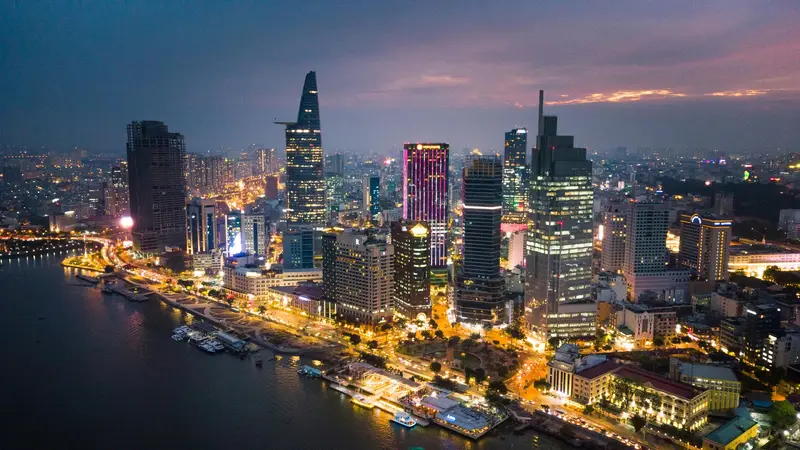
Ho Chi Minh City is Vietnam’s economic engine and its most international city: a fast, warm, chaotic metropolis of about 14 million people where you can live well for a fraction of the cost of Singapore or Hong Kong. The move itself is manageable if you do things in the right order: legal status first (visa, work permit, residence card), then housing near your work or school, then banking, insurance and the rest.
Two things changed recently that every newcomer should know. Since 1 July 2025 the city has merged with Bình Dương and Bà Rịa–Vũng Tàu, and districts were abolished in favour of wards and communes, so addresses are changing (people still say ‘District 1’ or ‘District 2’). And Metro Line 1 has run from Bến Thành to Suối Tiên since December 2024, reshaping where people can live. This guide links to detailed pages on each step.
Step 1: legal status — visas, work permits and residence cards
- Arriving: check whether your passport gets visa-free entry, or apply for the 90-day e-visa on the official portal. Details: visas and e-visa.
- Working: your employer must obtain a work permit or a certificate of exemption for you under Decree 219/2025. Start gathering legalised degrees and police checks early. Details: work permits and business.
- Staying: with a work permit you can get a temporary residence card (TRC), valid up to two years for workers, which replaces repeated visa runs. Family members can get dependant cards.
- No digital nomad visa: Vietnam has none; remote workers on tourist e-visas are in a legal grey area.
Bring originals and several certified copies of degrees, marriage and birth certificates (for dependants), and police checks; most need consular legalisation in the issuing country.
Step 2: choose an area
| Area (old name → now) | Feel | Best for |
|---|---|---|
| Thảo Điền / An Phú (D2 → An Khánh, Bình Trưng) | Leafy, villas, cafés, international schools, Western groceries; on Metro Line 1 | Families, first-time expats |
| District 1 (→ Sài Gòn, Bến Thành, Tân Định, Cầu Ông Lãnh) | The centre: offices, nightlife, walkability, noise | Singles and couples working downtown |
| District 3 (→ Bàn Cờ, Xuân Hòa, Nhiêu Lộc) | Tree-lined streets, local life, close to D1 | People who want ‘real Saigon’ near the centre |
| Bình Thạnh (→ Thạnh Mỹ Tây and others) | High-rise condos (Vinhomes Central Park, Landmark 81), good value | Condo living close to D1 |
| Phú Mỹ Hưng (D7 → Tân Mỹ, Tân Hưng) | Planned, spacious, quieter; Korean, Japanese and Taiwanese communities | Families at Saigon South schools |
| Thủ Đức (east) | New townships, universities, Hi-Tech Park; cheaper | Tech workers, students, metro commuters |
Choose by commute: crossing the river or the city in rush hour can take an hour. Families should pick the school first. See neighbourhoods, districts → new wards and the metro guide.
Step 3: housing
Start in a serviced apartment or hotel for a few weeks, view in person, then sign a 6- or 12-month lease. Crowd-sourced Numbeo data (November 2026) averages about VND 15.9 million a month for a central one-bedroom and VND 34 million for a central three-bedroom, with wide ranges. Expect a deposit of one to three months.
Make sure your landlord registers your temporary residence with the ward police within 12 hours of moving in: you need it for your TRC, visa extensions and bank account. Full guide: renting and housing.
Step 4: schools
International schools cluster in Thảo Điền, Thủ Thiêm and Phú Mỹ Hưng and teach IB, British, American, Australian and Canadian curricula. Tuition for 2026–27 reached about US$38,000 a year at the top end, plus admission and development fees; bilingual and Vietnamese private schools cost much less. Apply early. Full guide: international schools.
Step 5: healthcare and insurance
Register with an international clinic near home, keep the 24-hour emergency numbers of a private hospital in your phone, and buy international health insurance with direct billing; employees on local payroll are also enrolled in state insurance. Vaccinations, dengue and air quality are covered in healthcare; numbers to call in emergency.
Step 6: money, phone and paperwork
- SIM card: get a local number on day one with your passport; see SIM and internet.
- Bank account: usually needs a longer-term visa or TRC and proof of address. A local account lets you pay rent and use QR payments everywhere; see money.
- Tax: after 183 days a year you are tax resident and pay 5–35% on worldwide employment income; see work and business.
- Driving: you need a Vietnamese licence or a 1968-convention IDP; foreign licences can in some cases be converted to a Vietnamese one. See motorbikes.
- Apps to install: Grab or Xanh SM (rides, food), a banking app, Zalo (Vietnam’s main messaging app, used by landlords and businesses) and Google Maps.
Step 7: settle in
- Language: learn greetings, numbers and food words; take classes if staying long. See Vietnamese phrases.
- Etiquette: see etiquette and tipping.
- Community: most expat life is organised through Facebook groups and Zalo communities by area (Thảo Điền, District 7), nationality, profession and hobby; through chambers of commerce such as AmCham, EuroCham and BritCham; and through sports clubs, running groups and volunteering. Treat group advice as anecdotal and check facts with official sources.
- News: follow our news digest and English-language outlets in media.
- Costs: see cost of living for monthly budgets.
Shipping your belongings
International movers handle door-to-door shipping and Vietnamese customs clearance; see logistics and movers. Foreigners with a work permit or residence card can usually import personal effects, but rules on duty-free allowances, used electronics, alcohol and vehicles are specific, so get your mover to confirm what is allowed before you pack. Many expats ship little and buy furniture locally (furniture and home).
Bringing pets
Dogs and cats can be imported, but you need a veterinary health certificate from your home country, proof of rabies vaccination and microchipping, and an import procedure with Vietnam’s animal health authorities on arrival; requirements and timings vary by origin country and airline. Plan months ahead and use a pet relocation company. In HCMC, international vets include Animal Doctors International and Thonglor Pet Hospital; see veterinary. Many apartment buildings restrict pets, so ask before signing a lease.
First-week checklist
- Get a local SIM and install Grab/Xanh SM, Zalo and your bank’s app.
- Confirm your landlord or hotel has registered your temporary residence.
- Register at a nearby international clinic; save emergency numbers.
- Open a bank account (if your visa allows) and set up QR payments.
- Start work permit and TRC paperwork with your employer.
- Learn ten words of Vietnamese, and walk your neighbourhood.
Frequently asked questions
Is Ho Chi Minh City a good place for expats?
For many people, yes: it offers a lively city, good food, a large international community and low daily costs. Traffic, heat, air quality and paperwork are the common complaints.
What do I need to live in Vietnam long term?
Usually a job with a work permit (or an exemption), then a temporary residence card. Investors and family members of Vietnamese citizens have their own routes.
Where do most expats live in Ho Chi Minh City?
Thảo Điền and An Phú (old District 2), District 1, District 3, Bình Thạnh and Phú Mỹ Hưng (old District 7).
Can I live in Vietnam on a tourist visa?
Not as a long-term solution. The 90-day e-visa is for tourism; living and working long term needs the right visa, a work permit and a residence card.
What changed in Ho Chi Minh City in 2025?
From 1 July 2025 the city merged with Bình Dương and Bà Rịa–Vũng Tàu, and districts were abolished; the city now has 168 wards, communes and a special zone. Old district names are still widely used.
Can I bring my dog to Vietnam?
Yes, with a health certificate, rabies vaccination and an import procedure on arrival. Requirements vary, so start early and check with a pet relocation company.
Sources
- National Assembly of Vietnam — Resolution 202/2025/QH15 on the HCMC merger (checked 2026-11-23)
- Baker McKenzie — Vietnam: new work permit rules (Decree 219/2025) (checked 2026-11-23)
- LawNet — temporary residence card validity (checked 2026-11-23)
- Numbeo — cost of living in Ho Chi Minh City (Nov 2026) (checked 2026-11-23)
- Tuổi Trẻ News — international school tuition 2026–27 (checked 2026-11-23)
- Việt Nam News — temporary residence declaration (Article 33) (checked 2026-11-23)
- LuatVietnam — new personal income tax regime for foreigners (checked 2026-11-23)