
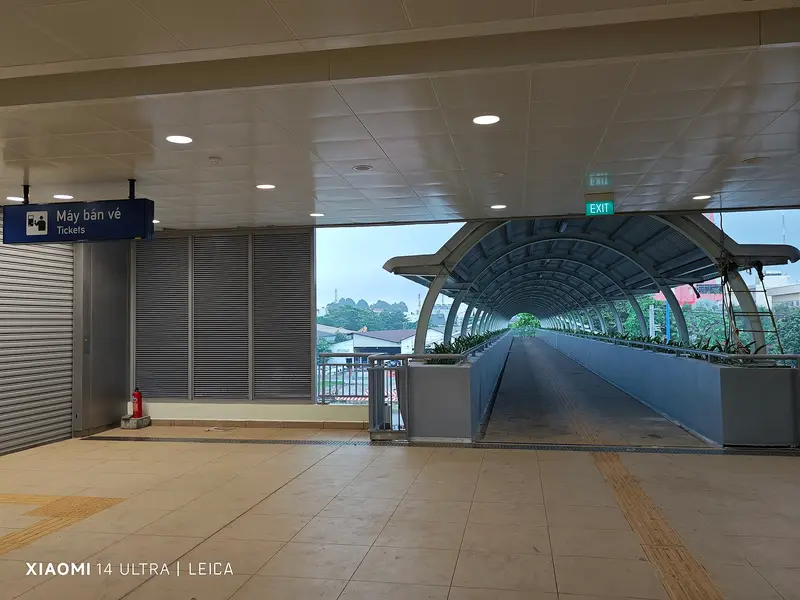
- Pay by
- Contactless card · machine (cash/card) · HURC app QR
- Single fare
- 7,000–20,000 VND
- Tap out?
- Yes, at the exit gate
- Food and drink
- Not allowed past the gates
- Bikes
- Folding bikes only, folded in a bag
Riding Metro Line 1 is easy: pay at the gate with a contactless bank card or a card from the ticket machine, go up (or down) to the platform for your direction, and tap or scan again to exit. Fares are charged by distance, so you must tap out as well as in.
The system is clean, air-conditioned and well signed in Vietnamese and English. The things that trip visitors up are small: a drink in your hand at the gate, a non-folding bike, or forgetting to collect a card deposit. This guide walks you through it.
Step by step: your first ride
- Find the station entrance. In District 1 the three stations (Bến Thành, Opera House, Ba Son) are underground; look for the metro logo and stairs or lifts down. From Văn Thánh Park onwards, stations are elevated; take the stairs, escalator or lift up.
- Decide how to pay. Easiest for visitors: a contactless Visa card (Mastercard has been reported to work) or phone wallet, tapped directly on the gate. Alternatively, buy a ticket at a vending machine or kiosk, or a QR ticket in the HCMC Metro HURC app.
- Buying at a machine: look for the language option on the screen, choose a single trip (select your destination station), a 1-day pass or a 3-day pass, then pay with cash (notes from 1,000 to 200,000 VND) or card. You receive an IC smart card. Cards carry a small refundable deposit (15,000 VND for a single-trip card, 35,000 VND for a 1-day or 3-day card).
- Finish food and drinks. Eating and drinking are not allowed beyond the gates, on platforms or trains.
- Tap in. Hold your bank card, phone or IC card on the reader, or scan your app QR code. Wait for the gate to open.
- Choose the right platform. Signs show the direction by terminus: Suối Tiên (outbound, towards Thủ Đức) or Bến Thành (inbound, to District 1).
- Board. Let passengers off first, and leave the marked priority seats for those who need them.
- Ride. Watch the on-board screens and announcements for your stop, and count stops against the line map.
- Tap out. Use the same card, phone or QR code at the exit gate; the fare is calculated here. A single-trip IC card is collected by the gate.
- Get your deposit back. If you bought a day or 3-day card, return it at a Fare Adjustment Machine (FAM) when you have finished with it to recover the deposit.
Which ticket should I buy?
| You plan to… | Best option |
|---|---|
| Make one or two trips | Tap a contactless card (cashless fare is about 1,000 VND cheaper) or buy a single-trip card |
| Make three or more trips in a day | 1-day pass, 40,000 VND |
| Explore over a long weekend | 3-day pass, 90,000 VND (three consecutive days) |
| Live here and commute | Monthly pass, 300,000 VND, or a stored-value card |
Single tickets are valid only on the day of purchase and are non-refundable. Full fares are on the Metro Line 1 guide.
Rules to know
- No eating or drinking past the gates, in lifts, on platforms or on trains. Sealed food in your bag is fine.
- No smoking or vaping anywhere in stations or trains.
- Folding bikes only (since 1 November 2025), fully folded in a bag up to 120×70×40 cm, and you can’t ride them in the station. Regular bicycles, e-scooters, skateboards and roller skates are not allowed.
- Pets only if small and in a cage or closed bag.
- Banned items include weapons, flammable materials, strong-smelling goods and balloons.
- Luggage: there is no published size limit. A cabin bag or medium suitcase should not be a problem; avoid peak hours with large bags.
Tips from regular riders
- Peak hours on weekdays are roughly 06:00–08:00, 10:30–12:30 and 15:30–18:30. Trains are more frequent then but busier.
- Last trains leave around 22:00. If you are out late in Thảo Điền, plan a Grab home.
- Combine with buses. Electric feeder buses (routes 153–169) connect stations with nearby neighbourhoods; see city buses.
- Combine with the river. Ba Son station is near the riverfront, and the waterbus has piers at Ba Son and Thảo Điền too, so you can go out by train and back by boat.
- Holidays. On some public holidays the metro has been free for everyone, with longer hours; check the public holidays page and local news.
Frequently asked questions
Do I need to tap out on the HCMC metro?
Yes. Fares depend on distance, so tap or scan again at the exit gate.
Can tourists use a foreign credit card on the metro?
Contactless Visa is accepted at the gates, and Mastercard was reported accepted. If a card is declined, buy a ticket at the machine with cash.
Can I bring a suitcase on the metro?
There is no published luggage limit, and ordinary suitcases are generally fine. Avoid rush hours with large bags.
Can I take my bike on the HCMC metro?
Only a folding bike, fully folded in a bag no larger than 120×70×40 cm.
Can I drink water on the metro?
Not past the ticket gates, on platforms or on trains. Keep sealed bottles in your bag.
How do I get the card deposit back?
Return 1-day and 3-day IC cards at a Fare Adjustment Machine in the station to recover the deposit.
Sources
- SGGP — passenger rules on Metro Line 1 (Jan 2025) (checked 2026-11-23)
- Tiền Phong — paper tickets end, folding bikes allowed (31 Oct 2025) (checked 2026-11-23)
- Tuổi Trẻ / Saigon Times — IC cards, deposits and FAMs (25 Jun 2025) (checked 2026-11-23)
- Tuổi Trẻ / Saigon Times — paper tickets stop at five stations (30 Oct 2025) (checked 2026-11-23)
- Tuổi Trẻ — Visa card payment on the metro (checked 2026-11-23)
- VOH — key rules for Metro Line 1 (checked 2026-11-23)
- Vietnam News — timetable and peak windows (Jul 2025) (checked 2026-11-23)