
- Signature dishes
- Cơm tấm, bánh mì, hủ tiếu, ốc, bánh xèo
- Street meal
- Roughly 30,000–80,000 VND (2025–26 reports)
- Best food areas
- District 4, District 3, Chợ Lớn, Bến Thành
- MICHELIN 2026
- 6 one-star restaurants in HCMC
- Vegetarian
- Look for “chay”; busiest on lunar 1st & 15th
- Payment
- Cash at stalls; QR/cards in restaurants
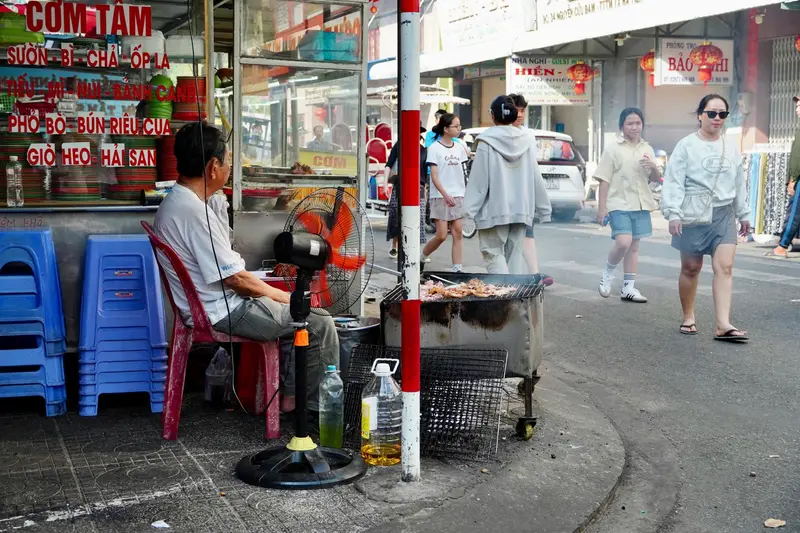
Saigon eats out, all day, on low plastic stools. Southern cooking is sweeter and more herb-heavy than the north’s, and the city absorbed Chinese, Khmer, French and central Vietnamese influences, so you can eat a different dish at every meal for a week. Start the day with cơm tấm (broken rice) or bánh mì, lunch on a noodle soup — phở, hủ tiếu or bún bò Huế — and spend the evening on ốc (snails and shellfish), grilled skewers or lẩu (hotpot) with friends.
This guide covers the dishes to know, the streets and markets to find them, roughly what you will pay, how to eat safely and politely, vegetarian food and the MICHELIN Guide’s Ho Chi Minh City selection. For a guided introduction, a street-food tour on your first night is the fastest way in (see tours).
Dishes to know
Cơm tấm (broken rice)
Saigon’s signature plate: fractured rice grains with a sweet-savoury grilled pork chop (sườn), shredded pork skin (bì), a steamed egg-and-pork cake (chả), pickles and fish sauce. Eaten at any hour, but breakfast stalls are the classic.
Bánh mì
A light, crackly baguette filled with pâté, cold cuts or grilled pork, pickled carrot and daikon, cucumber, chilli and coriander. Vendors sell from glass carts from early morning; variations include bánh mì chảo (a sizzling pan of egg and meat with bread on the side).
Phở
Beef (bò) or chicken (gà) rice-noodle soup from the north, done southern-style with a basket of fresh herbs, bean sprouts, lime and hoisin and chilli sauces on the table. Add herbs a few at a time.
Hủ tiếu
The south’s everyday noodle soup, of Chinese–Khmer origin: clear pork broth, chewy rice or tapioca noodles, pork, shrimp, liver and quail eggs, served in soup or dry (khô) with the broth on the side. Hủ tiếu Nam Vang (Phnom Penh style) is a Saigon favourite.
Bún bò Huế
A central Vietnamese noodle soup with lemongrass and chilli-oil broth, round thick rice noodles, beef shank and pork hock. Spicy by Saigon standards.
Bánh xèo
A crispy turmeric-yellow rice pancake filled with shrimp, pork and bean sprouts. Tear off a piece, wrap it in mustard greens or lettuce with herbs and dip in fish sauce.
Gỏi cuốn
Fresh (not fried) rice-paper rolls with shrimp, pork, rice vermicelli and herbs, dipped in a peanut-hoisin sauce. The fried version is chả giò.
Ốc (snails and shellfish)
Saigon’s favourite evening social food: dozens of snail and clam varieties, stir-fried with tamarind, salted egg, garlic butter or coconut, eaten with beer at shared tables. Order a few plates and pick with toothpicks.
Lẩu (hotpot)
A pot of broth on a burner, with meat, seafood, mushrooms and greens to cook at the table — sour fish (lẩu cá), goat (lẩu dê), Thai-style or mushroom. A group meal, and a good rainy-night choice.
Bột chiên, bánh tráng nướng and other snacks
Fried rice-flour cake with egg (bột chiên), grilled rice paper with egg and toppings (bánh tráng nướng, “Vietnamese pizza”), rice-paper salad (bánh tráng trộn) and grilled skewers are what students eat outside schools and parks in the evening.
Chè and sweets
Chè is a family of sweet soups and puddings — beans, jellies, coconut milk, tapioca, fruit — served hot or over ice. Also try sinh tố (fruit smoothies), flan (caramel custard, a French legacy) and fresh sugar-cane juice (nước mía).
Where to eat: streets, markets and neighbourhoods
- District 4 (Khánh Hội / Xóm Chiếu wards): Vĩnh Khánh street for ốc and grilled seafood from late afternoon; Xóm Chiếu market area for snacks.
- District 3: alleys off Nguyễn Thượng Hiền, Bàn Cờ market and the Lý Chính Thắng area for broken rice, noodle soups and chè.
- Chợ Lớn (District 5): dim sum, duck and roast meats, Chinese herbal desserts, and the night food stalls around Hà Tôn Quyền.
- District 10: Hồ Thị Kỷ alley for snacks and dessert at night.
- Bến Thành Market (District 1): a food court of noodle, broken-rice and dessert stalls inside the market; convenient but priced for visitors.
- Phú Nhuận / Bình Thạnh: Phan Xích Long and the streets around Hàng Xanh for hotpot, barbecue and late-night eats.
- Japanese quarter (Lê Thánh Tôn / Thái Văn Lung, District 1): ramen, izakaya and yakitori, an expat favourite.
Find specific places in street food, phở & noodle shops, Vietnamese restaurants and bakeries, desserts & bánh mì.
District 4 Street Food Walking Tour
A walking tour of District 4’s street food.
Check availability Booked on GetYourGuideMotorbike Street Food Tour with 12 Tastings
A street-food tour by motorbike with 12 tastings.
Check availability Booked on GetYourGuideNighttime Street Food Tour by Motorbike
An evening street-food tour by motorbike.
Check availability Booked on GetYourGuideA local food day
06:30–09:00 — breakfast. Saigon eats early. Broken-rice stalls, bánh mì carts and noodle shops do most of their trade before 09:00, and some sell out and close by mid-morning. Pair breakfast with a cà phê sữa đá at a pavement stall.
11:00–13:00 — lunch. Office workers pack cơm bình dân (“people’s rice”) canteens, where you point at dishes in a glass case — braised pork and egg (thịt kho trứng), sour soup (canh chua), stir-fried greens — served over rice. It is one of the cheapest and most varied meals in the city.
14:00–17:00 — snacks. Afternoon is for chè, fruit with chilli salt, bánh tráng trộn and sugar-cane juice, especially near schools and parks.
18:00 onwards — dinner and nhậu. Evenings are for sharing: ốc, grilled meats, hotpot and beer at crowded open-fronted restaurants (quán nhậu). Order several plates for the table rather than one dish each.
Chinese, Khmer and central flavours
Saigon’s food is a map of the people who settled here. Chợ Lớn (Districts 5 and 6) keeps Cantonese, Teochew and Hokkien traditions: dim sum in the morning, roast duck and char siu, wonton noodles (mì hoành thánh), herbal soups and Chinese sweet soups. Khmer influence shows in hủ tiếu and in fermented-fish dishes from the Mekong Delta such as bún mắm. Migrants from the centre brought bún bò Huế, mì Quảng and Huế-style rice cakes, and northern families brought phở and bún chả after 1954.
The result is that a single street can offer dishes from three regions. Ask locals what their family eats — it is the best way to find the next stall.
What it costs
Prices vary by neighbourhood more than by dish: the same bowl costs noticeably more around Bến Thành than in Gò Vấp. Travel guides updated in 2025–26 report roughly these street-level ranges; treat them as a guide, not a menu.
| Item | Street stall / simple shop (VND) | Notes |
|---|---|---|
| Bánh mì | about 15,000–40,000 | More for extra fillings or a famous shop |
| Phở / hủ tiếu | about 40,000–80,000 | Restaurant chains and tourist areas higher |
| Cơm tấm | about 35,000–70,000 | Depends on toppings |
| Iced coffee (cà phê sữa đá) | about 20,000–35,000 | Café chains and specialty shops cost more |
| Plate of ốc | varies widely | Check the menu or ask the price per plate |
Restaurants in District 1 and international places are priced closer to other Asian capitals. Fine dining tasting menus cost far more; check the restaurant’s site. Current exchange rates: VND rates.
Etiquette and how to order
- Sit down first. At most stalls you take a stool and someone comes to you; many places sell only one dish, so just say how many.
- Point and use simple words: một (one), hai (two), không cay (not spicy), tính tiền (the bill, please). More in Vietnamese phrases.
- Herbs and sauces on the table are free; the packaged wet towels (khăn lạnh) and peanuts sometimes cost a few thousand dong.
- Chopsticks: don’t stand them upright in rice (it recalls incense at funerals). Use the spoon for soup.
- Paying: pay at the end, usually at the table or to the owner at the cart. Many shops accept bank-transfer QR codes, but foreign cards rarely work at stalls; carry small notes. See money.
- Tipping is not expected at stalls; in restaurants, a service charge may be on the bill. See etiquette & tipping.
Hygiene and staying well
Busy stalls with high turnover and food cooked in front of you are the safest bet. Most ice served in the city is factory-made, and many residents consider the cylindrical tube ice safe; if you have a sensitive stomach, go easy on ice and raw herbs at first. Drink bottled or filtered water, not tap water. Peel your own fruit. If you do get sick, pharmacies are everywhere and international clinics are listed in healthcare.
Food allergiesFish sauce, shrimp paste, peanuts and MSG are everywhere. Carry a written card in Vietnamese describing your allergy, and choose restaurants with menus listing ingredients.
Vegetarian and vegan (chay)
Vietnam has a strong Buddhist vegetarian tradition. Look for “chay” (vegetarian) or “cơm chay” (vegetarian rice) on signs, often near pagodas. Many Buddhists eat vegetarian on the 1st and 15th of each lunar month, when chay restaurants are busiest. Dishes use tofu, mushrooms and mock meats; ask for không nước mắm (no fish sauce) at ordinary stalls. Modern vegan cafés cluster in District 1, District 3 and Thảo Điền.
Browse vegetarian & vegan restaurants, or join a vegetarian food tour.
Guided Vegetarian Food Tour by Motorbike
A guided vegetarian food tour by motorbike.
Check availability Booked on GetYourGuideMICHELIN Guide restaurants
The fourth MICHELIN Guide Vietnam, announced on 4 June 2026, covers Hanoi, Ho Chi Minh City and Đà Nẵng with 193 establishments nationwide, including 11 with one star. In Ho Chi Minh City, Ănăn Saigon, Akuna, CieL, CoCo Dining and Long Triều kept their stars and Upstairs gained one, making six starred restaurants in the city by our count of the published list. The city also added five new Bib Gourmand entries (good food at moderate prices), several of them street-food and noodle shops.
Starred restaurants need booking, often weeks ahead. For the full selection, see the MICHELIN Guide’s own site; our directory groups fine dining and Vietnamese restaurants.
Delivery, drinks and more
Food delivery apps (GrabFood, ShopeeFood and others) are how many residents eat at home; see food delivery & ride apps. For drinks, see coffee culture and nightlife. Learn to cook the dishes yourself in a cooking class.
Frequently asked questions
What food is Ho Chi Minh City famous for?
Cơm tấm (broken rice with grilled pork), bánh mì, hủ tiếu noodle soup, bánh xèo pancakes and ốc (snails), plus Chinese food in Chợ Lớn.
How much does street food cost in Saigon?
Travel guides in 2025–26 report roughly 15,000–40,000 VND for a bánh mì and 40,000–80,000 VND for a bowl of noodles, more in tourist areas.
Is street food in Ho Chi Minh City safe?
Generally yes at busy stalls where food is cooked fresh. Drink bottled or filtered water and ease in if you have a sensitive stomach.
How many MICHELIN-starred restaurants are in Ho Chi Minh City?
Six one-star restaurants in the 2026 guide by our count: Ănăn Saigon, Akuna, CieL, CoCo Dining, Long Triều and newly starred Upstairs.
Is it easy to eat vegetarian in Saigon?
Yes. Look for “chay” restaurants, often near pagodas, and ask for no fish sauce (không nước mắm) at ordinary stalls.
Where is the best street food area in Ho Chi Minh City?
District 4’s Vĩnh Khánh street for seafood and snails, District 3’s alleys for everyday dishes, and Chợ Lớn for Chinese food.
Sources
- MICHELIN Guide — Vietnam 2026 ceremony (4 Jun 2026) (checked 2026-11-23)
- Vietnam Investment Review — Vietnam reaches 11 Michelin-starred restaurants (checked 2026-11-23)
- Tuổi Trẻ News — 4th MICHELIN Guide Vietnam features 193 establishments (checked 2026-11-23)
- Vietcetera — $1 vs $10 bánh mì in Saigon (Jul 2025) (checked 2026-11-23)
- Vietnamtourism.com — HCMC travel costs per day in 2026 (checked 2026-11-23)
- UK FCDO — Vietnam safety and security (checked 2026-11-23)